Claudeforce Isn't About Smarter AI. It's About AI‑Ready Business Capabilities.
Claudeforce may be more than a new AI integration. By combining frontier reasoning, enterprise context, and governed business actions within a trusted environment, it may be signaling a shift toward AI-ready business capabilities.

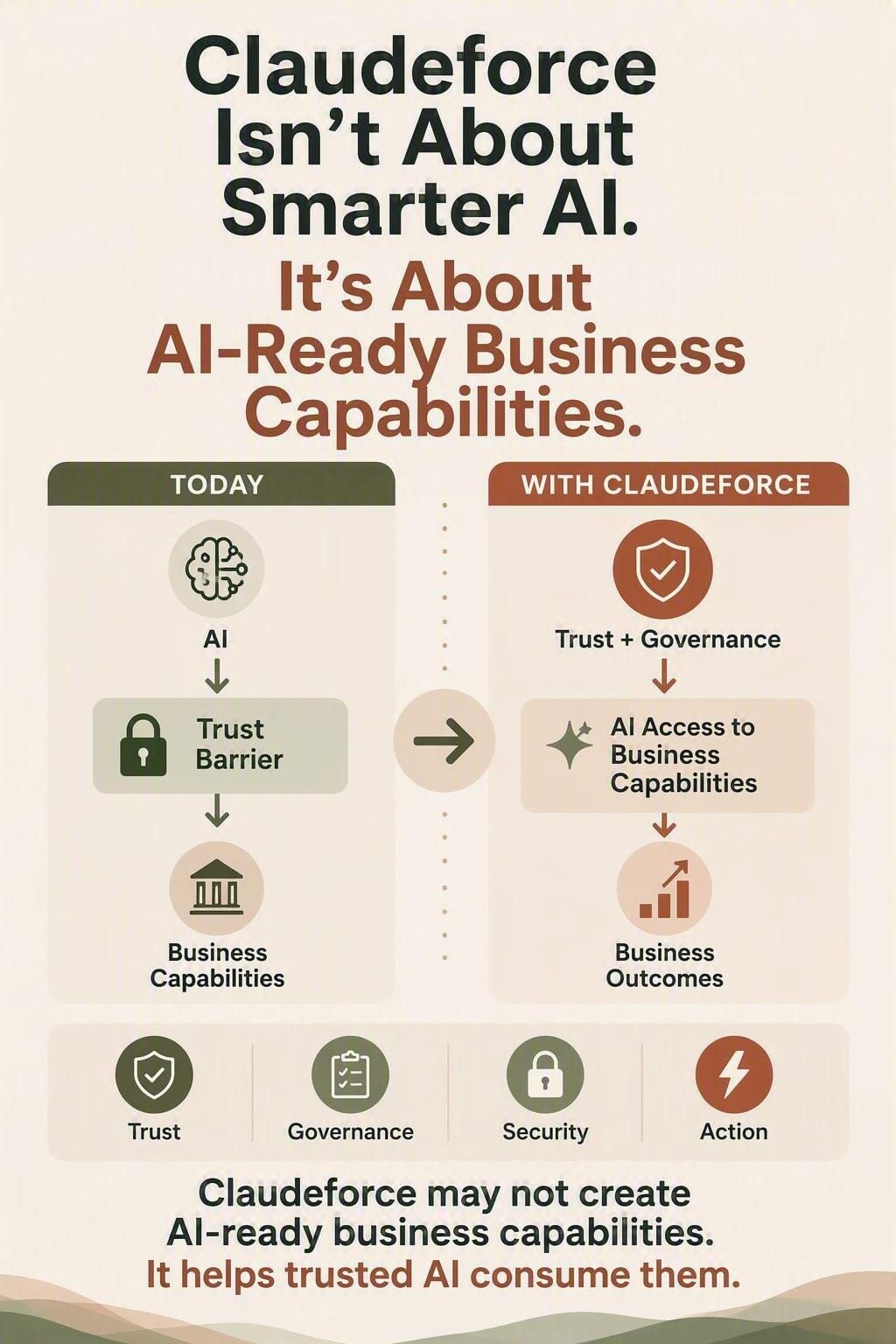
Why trusted access to enterprise context and governed actions may matter more than the model itself
When Salesforce announced Claudeforce, my initial question was:
Is Salesforce telling us Agentforce isn’t enough?
That now feels like the wrong question.
Agentforce has already demonstrated that enterprise agents can summarize information, assemble business context, recommend actions, create follow-up activities, and execute workflows.
Claudeforce is not introducing the idea that AI can reason and act.
The more interesting question is what happens when frontier reasoning can operate within a trusted enterprise environment and access governed business capabilities.
That is where the significance of Claudeforce begins.
Agentforce Already Enabled Enterprise Action
Agentforce provides the foundation for building and governing agents on Salesforce.
Those agents can combine enterprise data, instructions, tools, workflows, and actions to support business outcomes. Claude can now be selected as an AWS-hosted model for Agentforce, while Salesforce continues to provide the orchestration and execution environment.
Claudeforce adds another dimension.
Salesforce in Claude brings Salesforce context and actions into the Claude experience. It launches with 37 prebuilt sales skills for activities such as meeting preparation, deal-health reviews, pipeline management, record updates, and other governed actions. Salesforce says AIforce makes business data and workflows available to agents through MCP servers, APIs, and command-line tools.
This creates two complementary directions:
- Claude can provide reasoning within Salesforce and Agentforce.
- Salesforce capabilities can be accessed from within Claude.
The distinction is important.
Agentforce remains the platform for agents, orchestration, workflows, and governed execution.
Claude contributes frontier reasoning and natural-language interaction.
Claudeforce brings the two environments closer together.
The Real Barrier Was Trust
Regulated and data-sensitive industries have had access to powerful AI models for some time.
The barrier has not only been whether the model could reason.
The harder questions have been:
- Where will sensitive information be processed?
- Can the model provider access customer prompts and responses?
- Will enterprise data be used to train the underlying model?
- Will existing permissions and business rules still apply?
- Can AI-initiated actions be governed and audited?
- Can the solution operate within the organization’s risk and compliance requirements?
A model can perform impressively in a demonstration and still be unsuitable for production.
That is why the word trusted matters in the Claudeforce announcement.
But trust should not be accepted as a marketing label. It should be explained through the architecture.
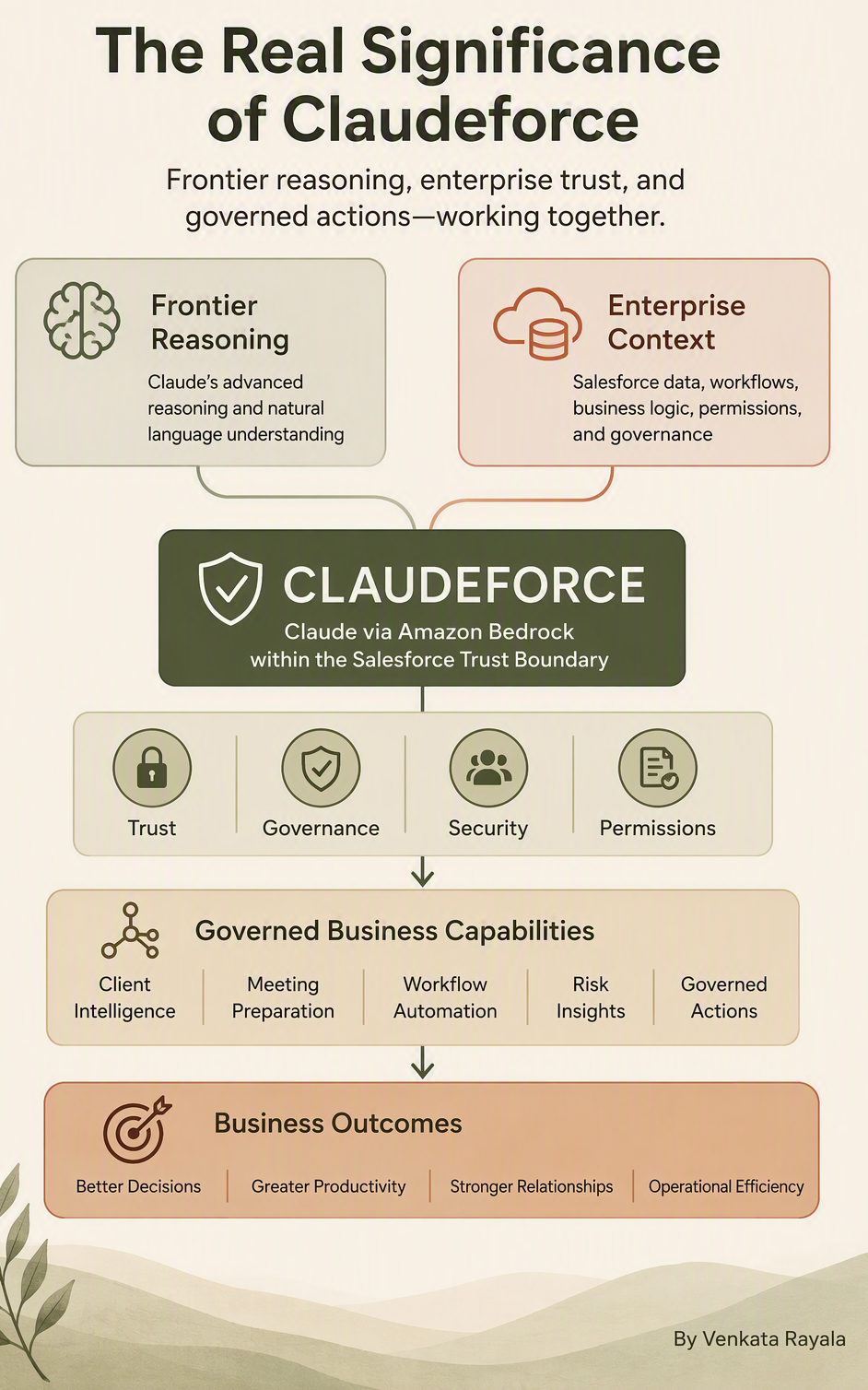
Why Is Claudeforce Considered More Trusted?
The precise description is:
Claude is made available through Amazon Bedrock within the Salesforce Trust Boundary.
Amazon Bedrock is the model-delivery mechanism.
The Salesforce Trust Boundary is the governed environment in which Salesforce data, permissions, business logic, workflows, and actions operate.
This distinction explains how the different components work together.
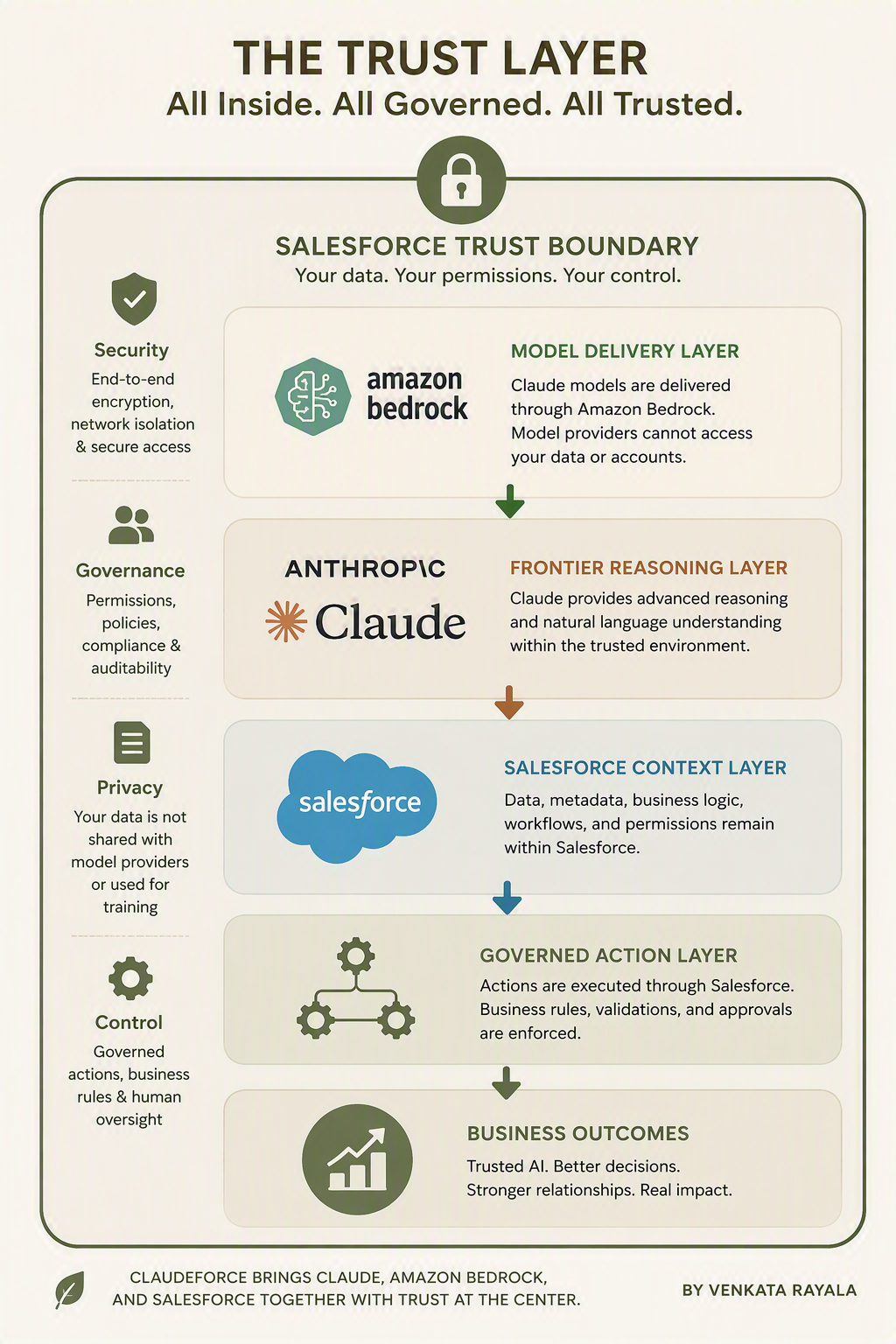
Amazon Bedrock provides the model-delivery layer
Salesforce offers Amazon Bedrock-hosted Claude models within the Agentforce platform. Salesforce states that Claude traffic is contained within Salesforce’s virtual private cloud and that sensitive data and AI workloads can remain within Salesforce’s trusted environment.
AWS explains that Amazon Bedrock uses dedicated model deployment accounts operated by the Amazon Bedrock service team. AWS also states that model providers cannot access those deployment accounts and that model invocation communications remain within the AWS network.
This separates access to the model from access by the company that created the model.
Anthropic develops Claude, but AWS operates the Bedrock deployment environment used to process these invocations.
Customer prompts are not shared with model providers
AWS states that Amazon Bedrock does not share customer input or model output data with third-party model providers. It also states that the model providers cannot access the Bedrock model deployment accounts.
This is significant for organizations concerned about exposing regulated or confidential information directly to an external model provider.
It does not eliminate every data-protection obligation.
The enterprise must still determine what information may be supplied to AI, apply data classification policies, configure appropriate access, and monitor how the capability is used.
But it establishes an important technical separation between enterprise prompts and the third-party model provider.
Customer data is not used for model training
AWS also states that Amazon Bedrock does not use customer inputs and model outputs to train foundation models.
This addresses another major enterprise concern.
Using a frontier model through Bedrock does not mean that enterprise prompts and outputs become training data for that model.
Again, this does not make every AI use case automatically appropriate.
It gives enterprises a clearer and more controlled foundation for evaluating those use cases.
Salesforce governs enterprise access and execution
Protecting prompts is only part of the trust equation.
An AI system may handle information securely and still create risk if it can bypass permissions, validations, approvals, or business policies.
Salesforce states that Claudeforce combines Claude’s reasoning with Salesforce data, workflows, business logic, actions, and governance. Actions initiated through Salesforce in Claude are routed through Salesforce so that existing enterprise rules can be enforced.
The resulting separation of responsibilities is important:
- Claude interprets intent and reasons over the context made available to it.
- Salesforce determines which data and capabilities the user is permitted to access.
- Salesforce workflows and business rules govern how actions are executed.
- The enterprise determines where review, confirmation, or human approval is required.
Claude can provide probabilistic reasoning.
Salesforce provides deterministic enterprise controls.
Trusted enterprise AI requires both.
MCP Expands Access, but Does Not Replace APIs
MCP is another important part of the Claudeforce story, but its role should not be overstated.
APIs expose data and business functionality through defined contracts.
MCP gives AI applications a standard way to discover available resources and tools, supply appropriate parameters, and invoke them.
A simplified execution path might look like this:
User intent → Claude reasoning → MCP tool → API or workflow → Salesforce capability → Governed outcome
MCP does not replace APIs.
It frequently sits above existing APIs, workflows, and services, making those capabilities easier for AI assistants to discover and use.
MCP also does not make a poorly designed capability secure.
The underlying capability still requires:
- Authentication
- Authorization
- Reliable business rules
- Appropriate data access
- Input validation
- Error handling
- Observability
- Auditability
MCP provides the connection pattern.
Claude provides reasoning.
Salesforce provides enterprise context and governed execution.
Does More Context Make the Agent Smarter?
Not automatically.
MCP and APIs can make more enterprise context available to Claude. That additional context can help Claude generate a more relevant answer or choose an appropriate tool.
But the quality of the outcome still depends on:
- The accuracy of the underlying data
- The business meaning attached to that data
- The quality of capability and tool descriptions
- The permissions applied to the request
- The reliability of the business logic
- The orchestration and grounding strategy
- Testing and production observability
Claude provides reasoning capacity.
Enterprise systems provide business context.
MCP and APIs provide access mechanisms.
Salesforce provides governed action.
Claudeforce’s value comes from combining these elements, not from one element independently making everything smarter.
A Financial-Services Proof Point
The value becomes more concrete when viewed through a real business outcome.
Salesforce reports that RBC Wealth Management uses Claude through Amazon Bedrock in Agentforce within the Salesforce Trust Boundary. Rohit Gupta, Head of Digital Advisor Platforms at RBC Wealth Management, described the outcome:
“Because of Anthropic on Amazon Bedrock and Agentforce, we’re able to help our advisors with their most time-consuming task: meeting prep. This has saved them significant time, allowing them to focus on what matters most, client relationships.”
The significance of this example is not that meeting preparation is a newly invented business capability.
The business need already existed.
The client context already existed.
The workflows already existed.
The practical unlock was applying frontier reasoning through an environment designed to satisfy the trust requirements of a regulated institution.
That is a more meaningful measure of progress than whether one model performs slightly better than another on a benchmark.
How Enterprise AI Evolved
Claudeforce also fits into a broader progression in enterprise AI.
The following timeline is my interpretation of the industry’s evolution, not an official Salesforce roadmap.
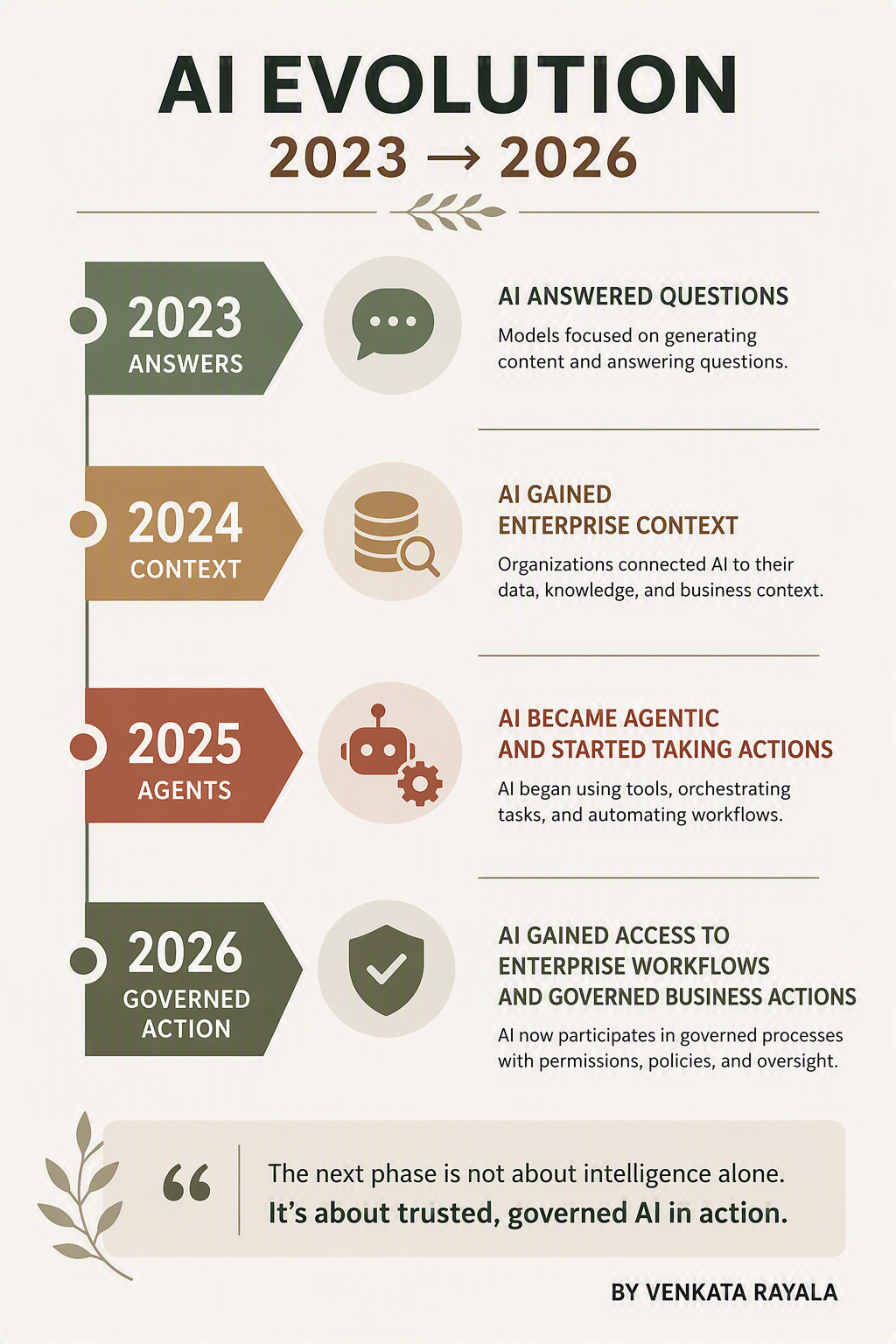
Enterprise AI evolved from answering questions to executing governed business actions. Claudeforce represents the latest step in that journey.
2023: Answers
Generative AI demonstrated that models could write, summarize, explain, and generate code.
The basic experience was:
Question → Model → Answer
The model was the center of attention.
2024: Enterprise context
Organizations discovered that a capable model without business context had limited enterprise value.
The focus moved toward enterprise search, retrieval-augmented generation, semantic retrieval, grounding, and data platforms.
The experience became:
Question → Enterprise context → Model → Answer
2025: Agents
The question changed from Can AI answer? to Can AI act?
Agents began invoking tools, coordinating workflows, retrieving information, and executing approved actions.
The pattern became:
Intent → Agent → Tools → Action
2026: Governed action
The next step is not action alone.
It is enterprise action governed by permissions, policies, workflows, and business rules.
The emerging pattern is:
Intent → Reasoning → Governed capability → Business outcome
This is the broader trend that Claudeforce represents.
The Rise of AI-Ready Business Capabilities
As frontier models continue to improve, the differences between assistants may become less important for many common enterprise tasks.
Multiple assistants may be able to summarize, reason, recommend, coordinate, and invoke tools.
The durable differentiator may then shift from the assistant to the business capability available behind it.
Instead of saying:
We built a meeting-preparation agent.
An enterprise could say:
We built a reusable meeting-intelligence capability.
Instead of creating a client-summary feature tied to one screen or assistant, the enterprise could create a governed client-intelligence capability that supports multiple experiences.
Potential consumers could include:
- Agentforce
- Claude
- Copilot
- Salesforce applications
- Mobile experiences
- Future AI assistants
The assistant becomes a channel.
The business capability becomes the durable asset.
What Makes a Business Capability AI-Ready?
An API alone does not make a capability AI-ready.
An AI-ready business capability needs several qualities.
Clear business meaning
The capability should represent a recognizable outcome, such as preparing for a meeting, evaluating risk, summarizing a relationship, or initiating an approved workflow.
Trusted context
The capability should have access to accurate, current, relevant, and permission-aware information.
Reusable access
The capability should not be permanently trapped inside one screen or user journey. It should be accessible through governed APIs, workflows, services, or agent tools.
Governed execution
Actions should pass through the same permissions, validations, business rules, and approval controls that apply to other enterprise channels.
Observable behavior
The organization should be able to determine:
- What was requested
- Which information was used
- Which capabilities were invoked
- What action was performed
- What outcome resulted
Appropriate human control
High-impact decisions and actions may still require review or approval.
AI readiness does not mean removing people from every process.
It means using human judgment where the consequences require it.
From Application-Centric to Capability-Centric Architecture
Enterprise architecture has evolved through several overlapping stages.
Organizations initially designed around applications.
They later exposed functionality through APIs.
More recently, they began building agents.
The next stage may be capability-centric architecture.
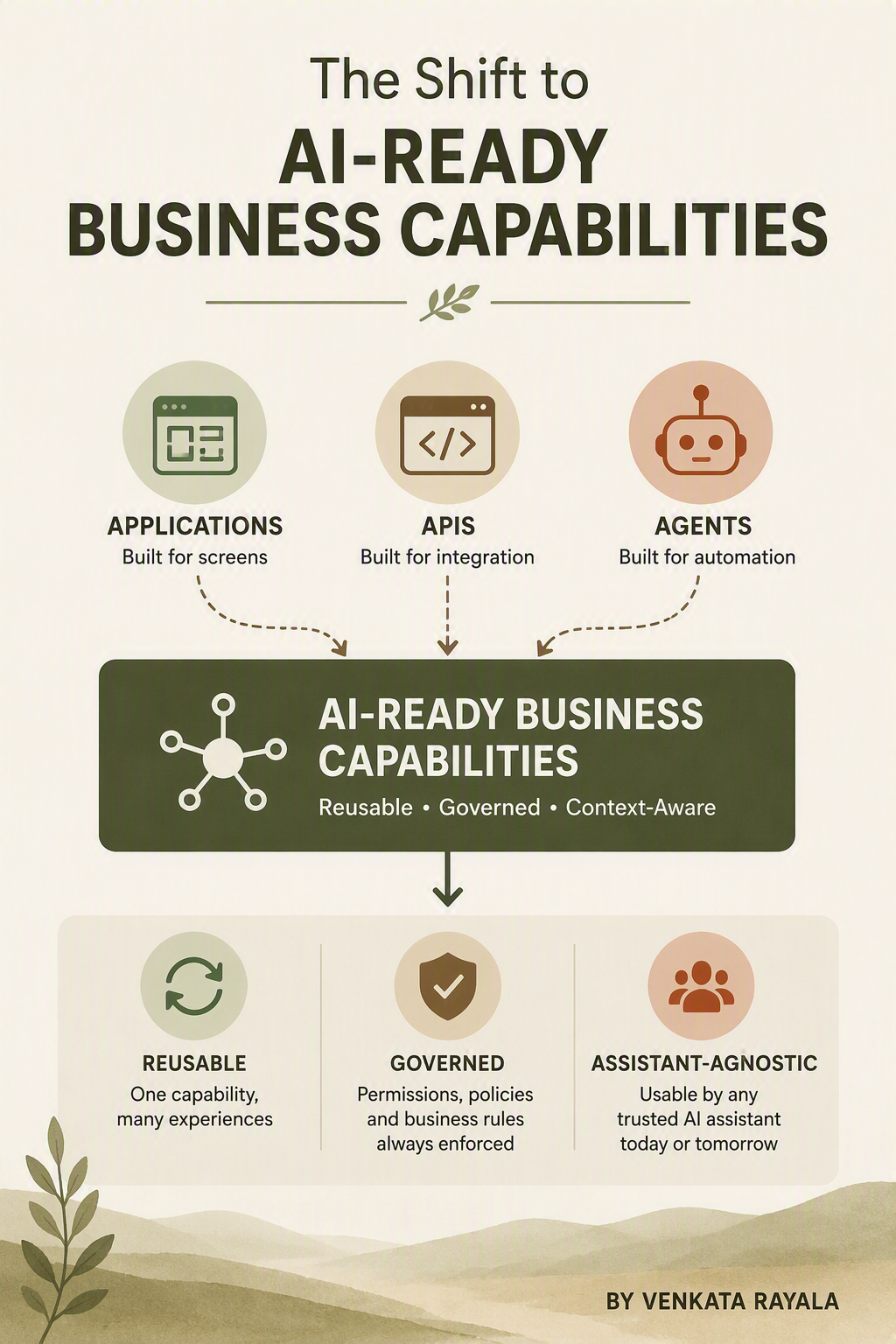
The future advantage may not come from the assistant an organization selects. It may come from the capabilities the organization builds.
Applications, APIs, agents, and assistants do not disappear.
They serve different purposes:
- Applications provide structured experiences.
- APIs provide reusable system contracts.
- Agents interpret intent and coordinate work.
- Business capabilities describe what the enterprise can reliably do.
In a capability-centric architecture, the organization does not rebuild the same business function for every new assistant.
The organization builds the capability once, governs it appropriately, and makes it available through approved channels.
Claudeforce Does Not Create Enterprise Readiness
Claudeforce does not automatically create clean data, reusable services, reliable workflows, or effective governance.
It cannot compensate for:
- Poor data quality
- Unclear business ownership
- Fragmented processes
- Inconsistent security
- Hardcoded business logic
- Missing observability
- Undefined approval requirements
The trust architecture makes frontier reasoning more practical to deploy.
The enterprise must still provide the business foundation behind it.
This distinction is essential.
Claudeforce does not create AI-ready business capabilities.
It increases the value of having them.
What Leaders Should Do
Business leaders
Start with operational friction, not model selection.
Identify where employees spend time searching across systems, reconstructing context, re-entering information, coordinating routine work, or waiting for decisions.
Those are potential candidates for AI-ready capabilities.
CIOs
Establish a trusted path from AI reasoning to enterprise action.
That path should include identity, access control, data protection, business rules, monitoring, auditability, and human review.
The objective should not be unrestricted automation.
It should be governed business outcomes.
Architects
Design capabilities that can outlive the current assistant.
Separate the business outcome, data access, deterministic rules, and execution controls from a specific model or conversational interface.
For every proposed AI use case, identify:
- The business capability being exposed
- The authoritative source of context
- The permissions that apply
- The rules that must always be enforced
- The decisions that can use probabilistic reasoning
- The actions requiring human approval
- The observability and audit requirements
That is how AI experimentation becomes enterprise architecture.
Final Thought
The more I studied Claudeforce, the less I saw it as a story about adding another AI model to Salesforce.
It is a story about making frontier reasoning operational within an enterprise environment.
Amazon Bedrock provides the model-delivery mechanism.
The Salesforce Trust Boundary provides the governed environment.
Salesforce provides enterprise context, permissions, workflows, business rules, and actions.
MCP servers and APIs make approved capabilities accessible to AI experiences.
Claude provides the reasoning.
Together, these elements address a critical question for regulated industries:
Can frontier AI reason over sensitive business context and participate in enterprise workflows without abandoning established security and governance controls?
That is why trust matters.
But trust is the enabler, not the capability.
Enterprises must still build the clean data, reusable services, reliable workflows, policy-driven actions, observability, and human oversight behind the AI.
Models will change.
Interfaces will change.
Assistants will change.
Business capabilities will remain.
Claudeforce may not be creating AI-ready business capabilities.
It may be removing one of the biggest barriers to using them: trust.
Sources and Further Reading
This article reflects my interpretation of publicly available Salesforce and AWS documentation, announcements, and industry trends. Any architectural predictions or opinions expressed are my own.
Salesforce
- Salesforce and Anthropic Announce Claudeforce
- Salesforce and Anthropic Partnership for Regulated Industries
- Agentforce Supported Models Documentation
AWS
- Amazon Bedrock Data Protection
- Amazon Bedrock FAQs
- https://www.repost.aws/knowledge-center/amazon-bedrock-model-data-use