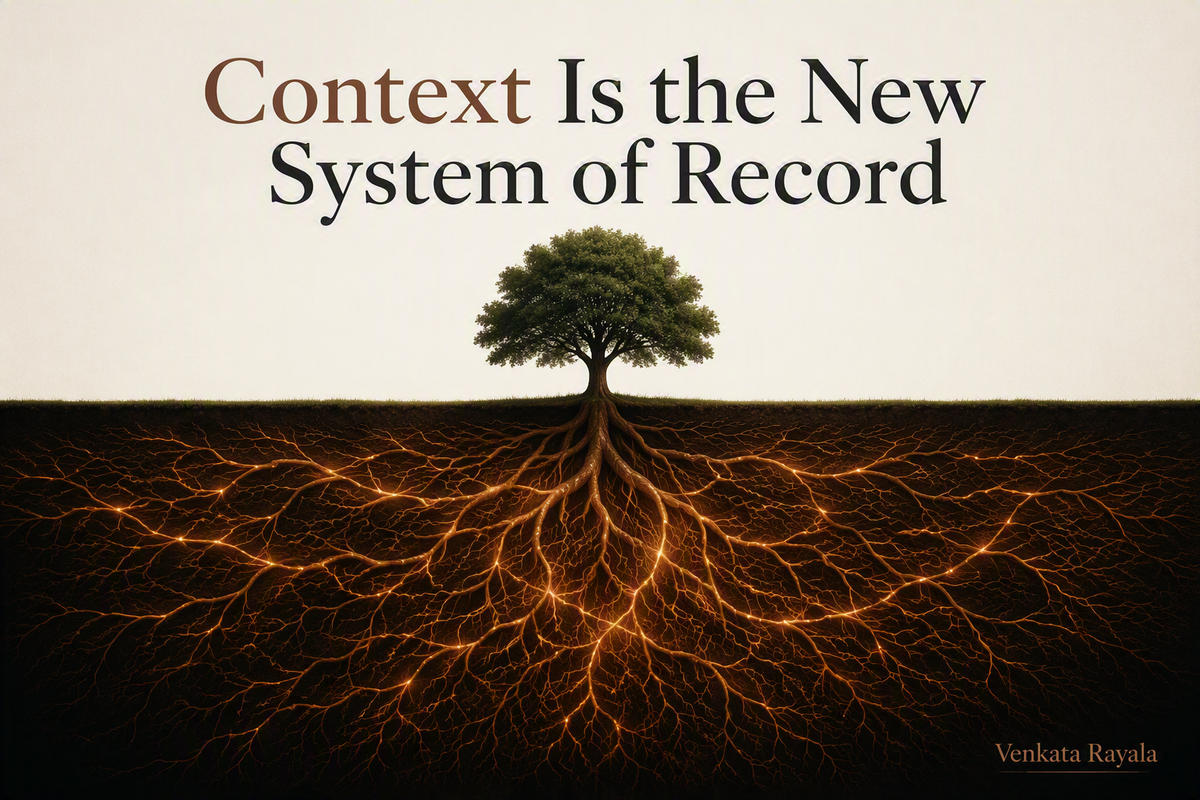
Context Is the New System of Record
Context Documents provide a common language that connects business stakeholders, architects, developers, support teams, and AI systems. As organizations adopt AI at scale, Context Documents may become the foundation of a new System of Record for Knowledge.

Why organizations need a system of record for knowledge, not just data.
Organizations have systems of record for customers, financials, employees, and code.
The next generation of organizations will build systems of record for knowledge.
Every business capability accumulates knowledge over time.
Business objectives evolve. Rules change. Architectural decisions are made. Integrations grow. Solutions mature. Teams change.
The knowledge remains, but the understanding often becomes fragmented.
Business stakeholders, Product Owners, Architects, Developers, Support Teams, and increasingly AI systems all interact with the same capability from different perspectives. Each group speaks a different language.
What organizations need is not more documentation.
They need a common language.
This is where the concept of a Context Document emerges.
A Context Document is more than a document. It is a shared understanding of a capability that can be consumed equally by business users, technical teams, support organizations, and AI systems.
In many ways, it becomes the organization's System of Record for Knowledge.
The most valuable part of a capability is often invisible. Context forms the foundation beneath everything that grows above it.
The Context Document
Traditional artifacts answer specific questions.
Requirements explain what was requested.
Architecture diagrams explain how a solution was designed.
Technical specifications explain implementation details.
Operational guides explain how a system is supported.
Each artifact provides part of the story.
A Context Document brings those perspectives together into a single understanding.
Its purpose is not to store information.
Its purpose is to preserve understanding.
A mature Context Document captures five dimensions of a capability.
Business Context
Why the capability exists.
The outcomes it supports.
The value it delivers.
Functional Context
Features, processes, workflows, and business rules.
How the capability behaves.
Technical Context
Architecture, integrations, data models, APIs, and security considerations.
How the capability operates.
Operational Context
Dependencies, monitoring, support considerations, and operational expectations.
How the capability performs in production.
Decision Context
Architectural decisions, trade-offs, assumptions, and historical considerations.
Why the capability evolved the way it did.
Together, these dimensions create a complete understanding that rarely exists in a single place.
Context connects business intent, functionality, architecture, operations, and decisions into a single understanding.
A Common Language Across the Organization
Every stakeholder views a capability differently.
Business stakeholders focus on outcomes.
Product Owners focus on capabilities.
Architects focus on design.
Developers focus on implementation.
Support teams focus on operational behavior.
AI systems focus on the context they receive.
A Context Document creates a common language across all of them.
Instead of repeatedly translating information between teams, everyone works from the same understanding.
The Context Document becomes the bridge between:
- Business and Technology
- Strategy and Execution
- Current Teams and Future Teams
- Humans and AI
It reduces the number of hours spent recreating knowledge through meetings, walkthroughs, presentations, and repetitive knowledge-transfer sessions.
Communication becomes more effective because understanding already exists.
AI Changes How Context Is Created
Traditionally, maintaining knowledge has been a manual effort.
As solutions evolve, documentation often struggles to keep pace.
AI introduces a different possibility.
Modern AI tools can analyze:
- Source code
- Metadata
- Configuration
- APIs
- Existing documentation
- Application behavior
This creates an opportunity to reverse engineer implemented solutions into structured organizational knowledge.
Most organizations focus on using context to generate code.
The more interesting opportunity may be the reverse.
AI should not only generate code from context.
AI should generate context from code.
As solutions evolve, AI can continuously generate and refine Context Documents, helping organizational understanding remain aligned with reality.
Knowledge becomes a living asset rather than a static artifact.

AI can transform implementation knowledge into reusable organizational understanding.
Context-Powered Development
One of the most immediate benefits of Context Documents appears during software delivery.
Every enhancement requires understanding before implementation can begin.
Business objectives must be understood.
Dependencies must be identified.
Existing capabilities must be evaluated.
Architectural constraints must be considered.
A Context Document consolidates that understanding into a single source.
When provided to engineering teams and AI-assisted development tools, it creates a stronger foundation for analysis, design, and implementation.
Without context, AI fills gaps with assumptions.
Those assumptions often result in duplicate functionality, unnecessary abstractions, additional dependencies, and what can be described as code creep.
Code creep occurs when software grows beyond what is actually required because the full context is not available during design and implementation.
With a Context Document, AI understands:
- Existing capabilities
- Business intent
- Architectural boundaries
- Reuse opportunities
- Established patterns
The result is greater precision.
Less code creep.
Less technical debt.
Less reinvention.
The goal is not to generate more code.
The goal is to generate the right code.
Context-Powered Learning
The value of a Context Document extends well beyond development.
Every organization continuously transfers knowledge.
New Product Owners join.
New Architects inherit solutions.
New Developers learn capabilities.
New Support Analysts onboard to applications.
Traditionally, onboarding requires meetings, walkthroughs, presentations, and documentation reviews.
A Context Document creates a different model.
Instead of reconstructing understanding from multiple sources, individuals begin with a complete view of the capability.
Business users gain business context.
Technical teams gain technical context.
Support teams gain operational context.
Everyone starts from the same foundation.
Onboarding accelerates.
Knowledge transfer becomes more efficient.
Dependence on institutional knowledge is reduced.

Knowledge transfer becomes acceleration instead of reconstruction.
From Documents to Organizational Intelligence
The real transformation occurs when Context Documents are managed as organizational assets.
Imagine every major capability maintaining a Context Document.
Imagine those Context Documents stored within a centralized repository.
The repository becomes more than a document library.
It becomes a knowledge platform.
Now imagine enterprise AI having access to that repository.
Employees no longer need to know where information resides.
They simply ask questions.
A Product Owner asks about business rules.
A Developer asks about existing functionality.
An Architect asks about dependencies.
A Support Analyst asks why a behavior exists.
The AI retrieves answers from organizational understanding rather than isolated information.
The Context Documents remain the source.
AI becomes the interface.
Knowledge becomes conversational.
From Prompt Engineering to Context Engineering
Much of today's AI discussion focuses on prompts.
Prompts are useful.
But prompts are temporary.
Context is reusable.
A single Context Document can support:
- Onboarding
- Knowledge transfer
- Impact analysis
- Solution design
- Support activities
- Future enhancements
- AI-assisted development
- Enterprise AI agents
The long-term advantage may not come from writing better prompts.
It may come from maintaining better context.
This is where Context Engineering emerges as a discipline.
The systematic practice of capturing, maintaining, and operationalizing organizational understanding.
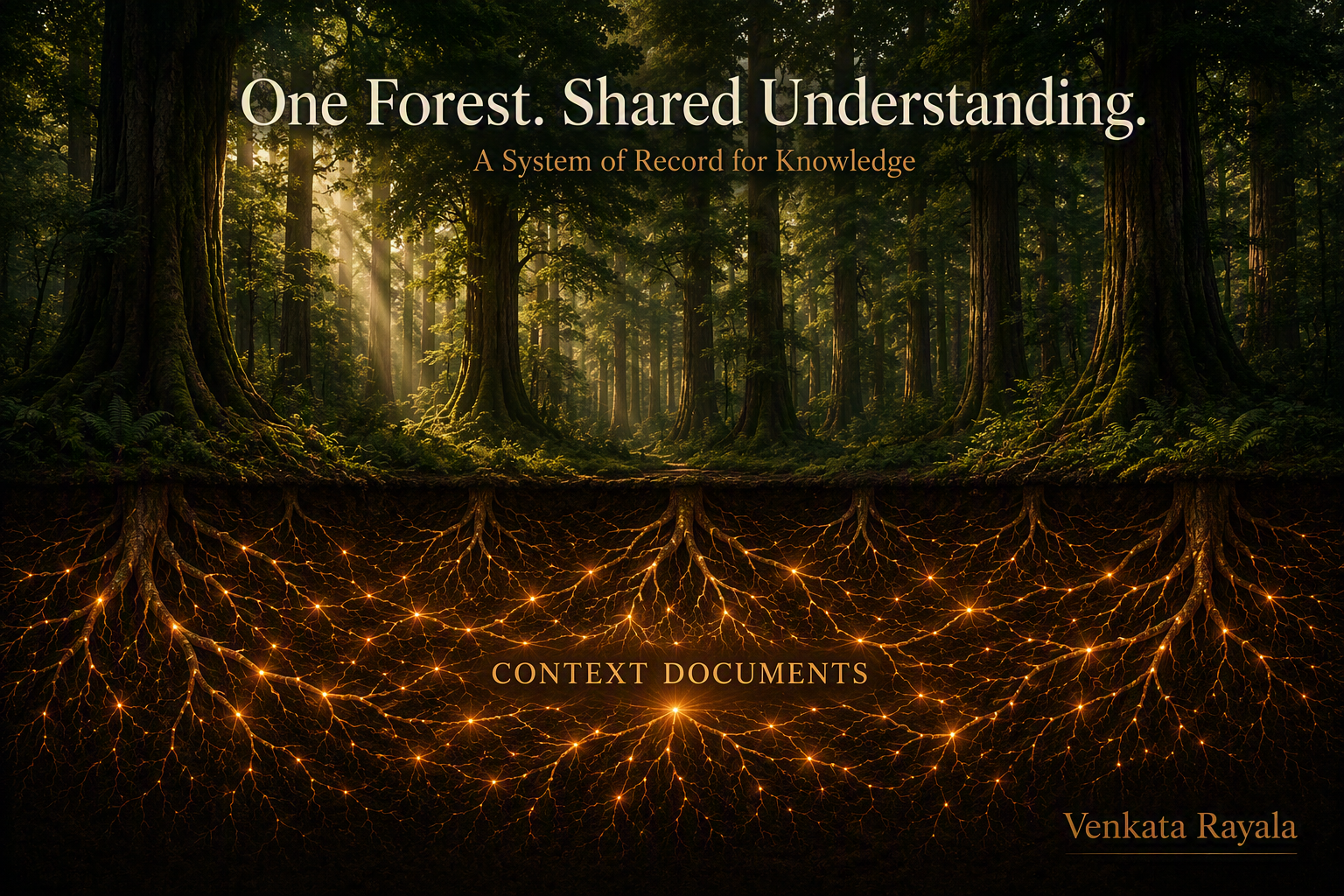
Connected knowledge becomes exponentially more valuable than isolated information.
Conclusion
Organizations have spent years reducing data silos.
The next challenge is reducing knowledge silos.
Context Documents provide a common language that connects business stakeholders, architects, developers, support teams, and AI systems through a shared understanding of a capability.
They preserve institutional knowledge, reduce the hours spent on repetitive knowledge transfer, support more precise AI-generated solutions, and help reduce code creep by keeping development grounded in context.
As AI becomes increasingly embedded across the software lifecycle, the organizations that manage context effectively will move faster, collaborate better, and make better decisions.
Because code explains what a system does.
Context explains why it matters.